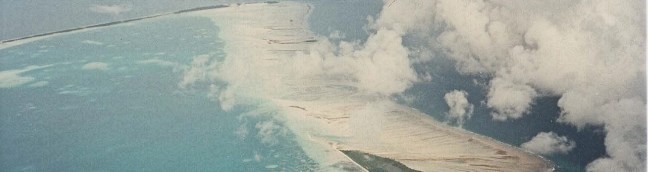
Recollections of a visit to Butaritari in the 1990’s
The Journey: With a start point of South East Queensland, there seemed to be just a couple of feasible options: find a passenger-carrying island freighter leaving Brisbane, or fly a circuitous route: local flight Brisbane-Sydney, Air Nauru to Bonriki Airport on Tarawa via Solomon Islands and Nauru, and finally a short hop Bonriki-Butaritari with Air Tungaru (a spectacular flight, worth getting wet from leaky window seals as we passed through rain squalls).
Butaritari: Arrival on Butaritari (on a startlingly short runway) came as a surprise to my island hosts: the hotel on Tarawa had tried to arrange short-wave radio contact but Butaritari wasn’t answering. Fortunately the guest house was available and the local school teacher was a ready and capable host, ensuring I was fed (lots of fish, pork, breadfruit and babai) as well as sharing the odd bottle of toddy and wrangling an invitation to a party with feasting and dancing. Accompanying this was a request to speak at the school (Panic: What to talk about? But the kids were indulgent and appreciated pictures of Queensland featuring hills and broad panoramas).
Compared to the urbanised Tarawa atoll, Butaritari conveys an impression of fertile bounty, of babai and bananas interspersed with pigs and poultry, of streets shaded by massive breadfruit trees (Butaritari breadfruit is great eating but the ubiquitous babai is more of an acquired taste).
Other impressions: Casual village life with foot traffic and bicycles, a truck tray substituting for a bus on longer trips; entertainment in the maneaba, mostly videos on a small screen; fishing from the beach or the canoe; solid church-owned buildings (the hospital, however, a simple thatched structure with raised floor); the thatched huts of the populace with retractable mats as side walls; the local shop a tiny kiosk in the middle of the main street; the beach rarely more than a hundred metres away.
If I had vaguely expected to see signs of the mystic practices for which Butaritari has a reputation, the closest I got was some amused references to the ‘walking ghost of Makin’ – for more on this, see Migrations, Myth and Magic from the Gilbert Islands: Early Writings of Sir Arthur Grimble.
Tarawa: Although there were other Europeans on Tarawa – business travellers in the hotels, Peace Corp volunteers, a few US Marines in town on some unspecified mission, a handful of expats working locally – simply being seen on the street got the local kids excited (‘I-Matang!* Hello!’) and drew curious glances from locals (catching a bus instead of driving a hire car made me a rare exception). Politeness abounded, no sign of the pushy, avaricious attention you get in some sad tourism hot-spots.
Since Then: The air terminal has been substantially upgraded, Tarawa has some new and imposing civic buildings and its population has swelled. International air connections are still infrequent and the islands are rarely found on cruise itineraries; the tourism economy remains sparse, for better or worse.
The Butaritari / Kiribati picture gallery at my author page is a personal view of these enticing locations.
* I-Matang: fair-skinned people, sometimes referred to as ‘ghosts’

 stuartmackenzieauthor.com
Stuart – a minor point. Matang is the mythical land from which the fair-skinned spirit ancestors of the I-Kiribati originated. Someone from Matang is called an I-Matang – the name given to Europeans in Kiribati today. The children would have been calling out, “I-Matang. I-Matang.” I have bought the book, and look forward to reading it.
LikeLike
Tawita
Thanks for the feedback, I’ve now corrected the posting. I had been wavering between the two alternatives when writing it but in the end relied upon faulty memory and/or less than authoritative sources. Hope you enjoy the book.
Regards
Stuart
LikeLike